
By: Bill Huston
Walk through almost any “up-and-coming” neighborhood in America, and you will see the same story playing out. The construction cranes in the sky are viewed as universal symbols of progress. We are told that rising skylines lift all boats—that the influx of capital will trickle down to the bodega owner, the artist, and the long-time resident.
But for the vast majority of communities, this is a lie.
For decades, traditional real estate development has operated as an extractive economy. Outside capital floods in, harvests value from local culture and cheap land, and exports the profits to distant REITs and institutional investors. The neighborhood gets “improved,” but the neighbors get displaced. The physical infrastructure upgrades, but the community wealth degrades. We are left with a shiny veneer of prosperity masking a hollowed-out economic core.
We have reached a breaking point. The old playbook of gentrification is no longer just ethically dubious; it is becoming financially risky due to community resistance and political gridlock.
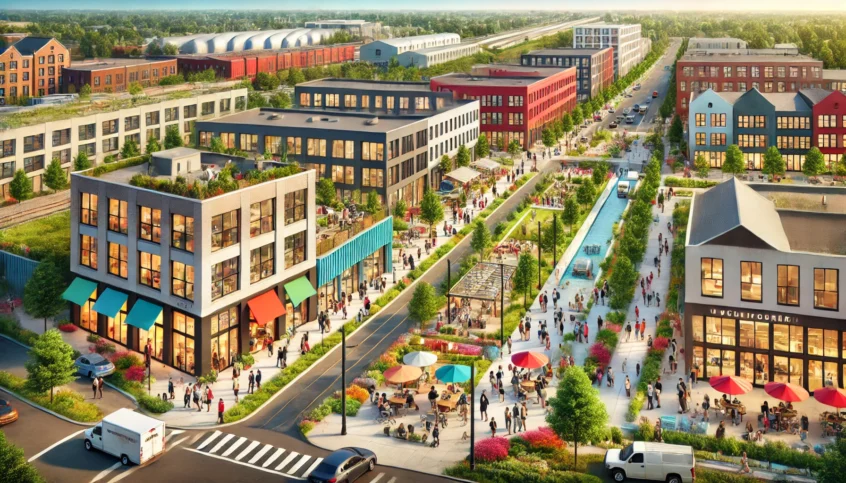
However, a new paradigm is emerging. It answers the question: What if the people who lived in the neighborhood owned the neighborhood? By combining the democratizing power of Real Estate Crowdfunding with the rigor of Impact Measurement & Management (IMM), we are not just tweaking the system—we are rewriting the code of capitalism. We are moving from an extraction economy to a generative economy, where development acts as a civic instrument for equity.
The New Architecture of Ownership
For the last century, commercial real estate has been a velvet-roped VIP club. The “capital stack”—the layers of debt and equity that fund a building—has been accessible only to accredited investors, banks, and private equity firms. This exclusivity meant that the appreciation of land value (wealth created by the community’s desirability) was privatized by those with the deepest pockets.
Real Estate Crowdfunding breaks down the velvet rope.
Thanks to regulatory shifts like Regulation Crowdfunding (Reg CF), the barrier to entry has plummeted from hundreds of thousands of dollars to as little as $100. This is not merely a fintech innovation; it is a structural revolution in property rights. It allows residents, local business owners, and community stakeholders to buy shares in the developments happening on their own blocks.
But why does this matter beyond the potential for a financial return?
From Displacement to Stewardship
When a resident transitions from a tenant to a shareholder, the dynamic shifts instantly.
- Agency replaces Anxiety: Instead of fearing rent hikes, residents benefit from asset appreciation.
- Alignment of Interest: Developers and the community are no longer adversaries. When the project succeeds, the neighborhood succeeds.
- Asset-Based Welfare: We stop trying to solve poverty with income alone and start solving it with assets.
This is the new architecture of ownership. It transforms the “Not In My Backyard” (NIMBY) energy into “Yes In My Backyard” (YIMBY) because the backyard actually belongs to the people standing in it.
The Strategy: Community Wealth Building (CWB)
Crowdfunding provides the mechanism for capital flow, but Community Wealth Building (CWB) provides the strategy for long-term resilience.
Crowdfunding a single building is a good start, but an isolated project cannot fix systemic wealth gaps. To create lasting change, we must integrate these investments into a broader CWB framework. This approach rejects the traditional economic development model of “chasing smokestacks” (luring outside corporations with tax breaks) in favor of strengthening local assets.
The core principle here is the Multiplier Effect. In an extractive model, a dollar spent at a national chain retailer leaves the local economy almost instantly. In a CWB model, that dollar circulates multiple times before leaving.
The Pillars of CWB Integration
To maximize the power of crowdfunding, we must layer in these complementary strategies:
- Anchor Institutions as Stabilizers: We must partner with local hospitals, universities, and municipalities. Instead of outsourcing, these “anchors” should direct their massive procurement budgets toward the local businesses occupying our crowdfunded developments.
- Broad-Based Ownership Models: Beyond the real estate itself, we encourage employee ownership (ESOPs) and cooperatives for the commercial tenants. This ensures that the profits from the business stay local, just as the profits from the building do.
- Local Procurement Ecosystems: Construction and maintenance should be sourced locally. When the dividends go to local investors, and the maintenance wages go to local contractors, you create a self-reinforcing loop of prosperity.
The result is an economy that is resilient by design, not by accident.
The Proof: Impact Measurement & Management (IMM)
This is where the “Wall Street” discipline must meet the “Main Street” mission. For too long, “impact investing” in real estate has been soft—governed by vague promises of “revitalization” and “community feel.”
If you cannot measure it, you cannot manage it. And if you cannot manage it, you cannot scale it.
To attract institutional capital alongside community dollars, we need robust Impact Measurement & Management (IMM) strategies. We must treat impact data with the same reverence we treat financial audits. This isn’t just about “doing good”; it’s about de-risking the asset. Projects with high community buy-in and verifiable social utility face fewer zoning battles, lower vacancy rates, and lower turnover costs.
The Metrics That Matter
A robust IMM framework for community real estate should track:
- Affordability Preservation: Not just “affordable units,” but the percentage of units permanently deed-restricted below 60% AMI (Area Median Income), and the ratio of rent growth to local wage growth.
- Wealth Creation for Residents: Tracking the dividend yield paid specifically to zip-code-local investors versus outside investors. We need to measure the localization of profit.
- Local Economic Velocity: The percentage of CapEx and OpEx spent with Minority/Women-Owned Business Enterprises (MWBEs) and local contractors.
- Environmental Justice: Metrics on carbon footprint reduction in historically polluted neighborhoods, verifying that green infrastructure benefits existing residents rather than displacing them.
By utilizing these KPIs, we move beyond storytelling to evidence-based development. We prove that equity and equity (financial) are not mutually exclusive—they are mutually reinforcing.
The Synergy of the New Model
Imagine two developments breaking ground on the same day in the same city.
Development A is the traditional model. It is funded by a sovereign wealth fund and a national bank. It is a glass tower of luxury studios. The ground floor is leased to a national coffee chain. The rents rise, the local deli across the street closes, and the long-term residents move two towns over. The profits leave the state immediately.
Development B is the Crowdfunded CWB Model. It is funded 40% by a local credit union and 60% by 500 local residents, including the teachers and nurses who work down the street.
- The ground floor is a food cooperative sourced from regional farms.
- The maintenance is handled by a local minority-owned firm.
- The IMM data shows that the building is carbon-neutral and has created 45 local living-wage jobs.
- Most importantly, every quarter, dividend checks are deposited into the bank accounts of the neighbors.
In Development B, the community is not the victim of the development; they are the beneficiaries. The wealth generated by the rising value of the neighborhood is captured by the people who built that value in the first place.
This is not charity. It is a superior economic engine. It creates a defensible, high-loyalty asset that outperforms because it is insulated from the volatility of speculative outside capital.
Conclusion: The Time to Pivot is Now
The era of “blind” capital is ending. Investors—from Gen Z day traders to family offices—are increasingly demanding that their portfolios reflect their values. But more than that, they are recognizing that the extractive model is running out of road. You cannot keep extracting value from a community until there is nothing left.
We have the tools. Crowdfunding democratizes access. Community Wealth Building structures the ecosystem. IMM verifies the truth.
To my fellow investors and developers: The question is no longer whether you should adopt these strategies, but whether your current portfolio can survive without them. Are your assets extracting value, or generating it? Are you building for a community, or with it?
Take the first step toward the Generative Economy.
I challenge you to audit your real estate holdings today. Look for the leakage. Look for the displacement. Then, let’s get to work on fixing it.
Let’s build something that lasts. Visit our website to join our newsletter!